
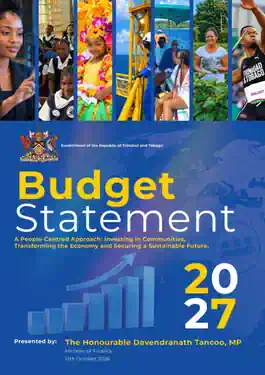
The Minister of Finance, Honourable Davendranath Tancoo presented the 2027 Budget Statement in the Trinidad and Tobago Parliament on October 12 2026.
The 2027 Budget Statement and related documents can be downloaded at https://www.finance.gov.tt/wp-content/uploads/2026/10/2026.10.12-2027-Budget-Statement-final-Minister-copy-formatted-002.pdf
Tracy Hackshaw used GenAI to create a Trinidad and Tobago Digital Economy 2027 document using the 2027 Budget Statement and Expenditure Reports
The rest of this post will focus on the ICT related aspects of the 2027 Budget Statement.
Page 27, under “Building on Our First Year, Moving Trinidad and Tobago Forward” :
We expanded digital public services to create a more
efficient customer-focused public sector through
VerifyTT, the country’s first national standard for digital
verifiable credentials; we implemented the long-overdue
Airport Online Arrival/Departure Forms expediting
passenger movement through our ports of entry...
We introduced electronic payments at the Customs
and Excise Division: In November 2025, LINX debit-
card service was introduced at the CED making payments
by importers and traders safer, faster and easier. Work is progressing to expand payment services to include
credit-card and online payment options all of which will
improve the ease of doing business and facilitate efficient
and effective trade.
Under “Rebuilding the Inland Revenue Division: Boosting
Revenue Collection, Improving Service Delivery” Page 43-44 :
The existing establishment [Inland Revenue Division] has been strengthened through the filling of 136 vacancies with an additional 102 Auditors to be onboarded this month.
Further, 24 ICT professionals will be transitioned to 3-
year contracts and a further 27 ICT professionals to be
onboarded during fiscal 2027.Additionally, $113.4 million was approved to upgrade
the Integrated Tax Processing System from antiquated
Version 9 which we inherited to Version 26, scheduled to
begin in early-2027 and completed within 18 months.For taxpayers, these upgrades mean more reliable online
services, faster processing, improved access to account
information and fewer manual transactions.For the Government, it will strengthen compliance, audit,
data analysis and revenue collection.
We are enhancing the exchange of information between
the Integrated Tax Processing System and the Customs
Border Control System to improve trader verification,
customs valuation, compliance monitoring, audit, risk
management and inter-agency collaboration. All of this
will drastically improve the ease of doing business.
Under “Enhancing Border Control and Customs
Administration” Pages 46
“The upgrade of ASYCUDA which commenced in October
2025 is advancing in partnership with UNCTAD.This initiative strengthens risk management and aligns
with Government’s overarching digitisation framework.
Complementing this initiative is the ASYHUB Port
Community System, which electronically connects
Customs with shipping agents, port operators and other
trading partners.”
Under “Combating Illicit Trade” , page 49
“We are implementing the Customs Recordation and
Information System to give customs officers access to
verified information on rights holders, authorised
distributors and shippers, and distinguishing product and
packaging features.This will improve the detection of counterfeit goods while
supporting more efficient clearance of legitimate
consignments.”
Under “Accelerating Digital Services: Bringing Government
Closer to the People” Page 88 :
Accelerating digital services is key to improving
productivity and efficiency.
Our digital transformation agenda will improve service
delivery, strengthen institutional capability, and build
greater national resilience.
Already, under the new VerifyTT initiative, 803 digitalcredentials were issued, 55,927 credentials were
uploaded to the platform, and 387 verification
transactions were completed. VerifyTT has been
integrated with EmployTT and the newly established
LearnTT.This digital eco-system enables citizens to securely store
and share trusted digital credentials while allowing
employers, educational institutions and Government
agencies to instantly verify their authenticity reducing
administrative processing times and minimising
document fraud.The TATT, has deployed 32 TTWiFi sites at schools and
hospitals and distributed more than 300 devices to
persons with disabilities.
We have also completed the Roxborough AI Centre in
Tobago and the Indian Trail AI Centre, alongside
support for digital training initiatives such as
ICT4Seniors and Tech4Girls.Our next phase includes the development of the:
- National Citizen Services Platform;
- CARE-TT social benefits wallet; and
- BenefiTT, to modernise the way citizens access
social benefits…..…..In February 2026, we launched the National AI
Academy.We are well advanced in modernising the Electronic
Transactions Act and the Data Protection Act and in
fiscal 2027 we will continue to develop CodeTT as a foundation for building local digital capability and fostering home-grown innovation.
Under “Tourism: Trinidad and Tobago, a Destination for
Visitors, Investment and Growth”, page 119 :
In fiscal 2027, we will launch the SailClear arrival and
departure digital clearance system, reducing yacht
processing times from approximately 4 hours to 15
minutes.
Under “Sport and Youth: Inspiring Excellence, Building
Industry”
We are revising the National Youth Policy and
developing a new National Service Policy to provide a
more coordinated, relevant and inclusive framework that
responds to the changing needs and aspirations of our
young people.
In fiscal 2027, we will launch 10 new skills programmes
in heavy machinery repairs,
- heavy equipment operations,
- automotive repairs,
- auto body works,
- motor rewinding,
- electric power transformers,
- construction tendering
- and cost training, forklift operations, manufacturing,
coding, and AI.
Under Education and Skills Training, page 136
“To ensure that our students are technologically
prepared, we are expanding digital educational
resources and electronic learning to 200,000
students, 12,000 teachers and 1,500
administrators;…...To bring our education system firmly into the digital
age, we will allocate $6.6 million to the AI in Education Programme, NEXTCLASS TT and ELEVATE TT. In 2026, we scoped and designed these programmes and in fiscal 2027 we will roll
them out;In fiscal 2026, we put 17,188 laptops in the hands of students across 154 schools. In fiscal 2027, we will invest $100 million dollars to continue to provide laptops to our children;
Under “Smarter Policing Through Technology”, Page 143
Criminal organisations are increasingly using technology
and sophisticated networks to hide their activities and
evade detection.
This Government is therefore evolving our approach to
policing through,
- an integrated digital platform and the expanded use
of facial recognition technology,- automatic licence plate recognition,
- geo-fencing, surveillance systems
- and other intelligence capabilities.
These tools will enhance our protective services’ ability to
identify crime hotspots, connect information across investigations, track suspicious activity, and deploy resources where they are most needed….
….To strengthen document security, fraud detection and the integrity of our borders, Trinidad and Tobago will transition to a modern Electronic Passport Issuing Control System in January 2027.
Under “Tobago: Investment, Tourism and Opportunity” Page 147
In fiscal 2027, the THA will advance e-government
services, digital payments and digitisation of public
records, supported by secure digital platforms.
Under “Fiscal and Other Measures” Page 163
5 Standard-rate all supplies of digital and
remote servicesMuch of the digital services consumed in Trinidad and
Tobago are supplied by businesses located outside of our
borders. These entities do not contribute to our country’s
income.Accordingly, the Government proposes to apply VAT to
digital services supplied by non-resident providers to
persons in Trinidad and Tobago.
To facilitate compliance and collection, a simplified
registration will be introduced for non-resident
suppliers, including suppliers of taxable services
connected with real property situated in Trinidad and
Tobago, allowing them to register, collect and remit
VAT electronically.
This measure will broaden our tax base, strengthen the
collection of VAT and promote more consistent tax
treatment between services supplied from abroad and
those supplied domestically.The measure will generate $18 million in revenue
and takes effect on March 1, 2027.
Under “Modernising Tax Administration and Strengthening
Compliance.” Page 181
Mandatory e-filling through GENTAX:
Government will introduce mandatory electronic filing
through the Inland Revenue Division’s GENTAX system
for all taxpayers.
This measure represents an important step in the
modernization and digital transformation of tax
administration in Trinidad and Tobago.
GENTAX will provide all taxpayers with a single,
streamlined and more efficient platform through which
they can meet their tax obligations without having to
manually file returns.This removes unnecessary administrative barriers while
strengthening compliance.
It facilitates more effective administration of the tax
system and provide greater convenience to taxpayers.
Under “Improving the Foreign Investment Regulatory
Framework:” Page 196
31 Transitioning to a Permanent Regulatory
Framework for Virtual Assets:
The existing transitional arrangements under the Virtual
Assets and Virtual Asset Service Providers Act, 2025 are
due to expire on December 31, 2026.Government proposes to extend the existing regulatory
sandbox and provide for full licensing of virtual assets
and service providers.
This will include strengthening governance, cybersecurity,
consumer protection, safeguarding of client assets,
financial integrity and regulatory oversight.
This measure will take effect from January 1, 2027.
Under “Empowering the Average Citizen through
Expanded Investment Opportunities” Page 201
This programme [Retail Government Securities Programme] will be supported by the Government’s
move towards the dematerialisation of Government
securities, replacing paper certificates.
The securities will be recorded electronically through the
Trinidad and Tobago Central Depository and will be listed
on the Trinidad and Tobago Stock Exchange, with trading
facilitated through licensed brokers.