So, if you’re using Java, you should probably update. ASAP.
You can download Java at http://www.java.com/en/download/index.jsp or if you want to manually download Java for Windows, Mac, Linux, see
http://www.oracle.com/technetwork/java/javase/downloads/jre7-downloads-1880261.html
If you have older versions of Java, you should remove them as soon as possible. The http://www.java.com/en/download/faq/remove_olderversions.xml page has more information and tools on how to remove older versions of Java.
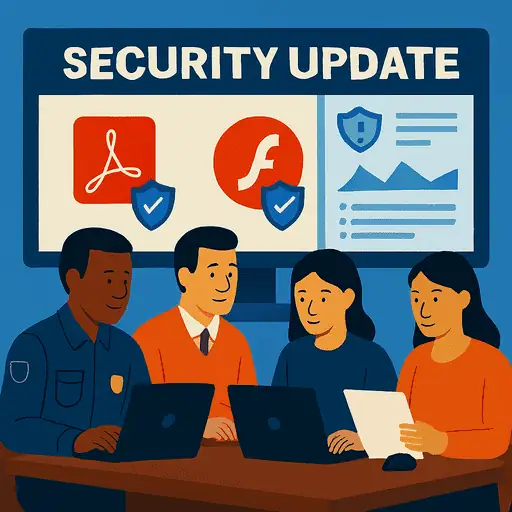
Adobe has updated its Adobe Reader software (used to view PDF files) and Acrobat software for Windows and Macintosh to “address vulnerabilities that could cause a crash and potentially allow an attacker to take control of the affected system”.
Such vulnerabilities in Adobe Reader (and Acrobat) before January 14 2014 could allow for execution of unwanted code (typically installing malware or viruses/worms on your PC), without your consent just by opening a PDF.
The affected software versions of Adobe Reader and Acrobat are
Adobe Reader XI (11.0.05) and earlier 11.x versions for Windows and Macintosh
Adobe Reader X (10.1.8) and earlier 10.x versions for Windows and Macintosh
Adobe Acrobat XI (11.0.05) and earlier 11.x versions for Windows and Macintosh
Adobe Acrobat X (10.1.8) and earlier 10.x versions for Windows and Macintosh
Read Adobe’s security bulletin at http://helpx.adobe.com/security/products/acrobat/apsb14-01.html for instructions on how to update Adobe Reader and Acrobat.
Adobe Flash Player 11.9.900.170 and earlier versions for Windows and Macintosh,
Adobe Flash Player 11.2.202.332 and earlier versions for Linux.
to “address vulnerabilities that could potentially allow an attacker to take control of the affected system.”
You can read the security bulletin from Adobe at http://helpx.adobe.com/security/products/flash-player/apsb14-02.html (which is a new location for Adobe security bulletins) but the vulnerabilities in versions of Adobe Flash before January 14 2014 could allow for execution of unwanted code (typically malware), without your consent just by visiting a website with malicious Flash applications or video (SWF). Therefore, you should update your Adobe Flash Player to the latest version to close this loophole.
To determine what version of the Adobe Flash player you have on your Windows, Macintosh or Linux system, visit http://www.adobe.com/software/flash/about/
To download the latest version of Adobe Flash Player, visit http://www.adobe.com/products/flashplayer/distribution3.html
Windows users should note that the Flash Player in Microsoft Internet Explorer v9 and earlier and the Flash player in web browsers like Opera, Mozilla Firefox and Safari are separate installs. You should install and update both versions of Adobe Flash.
For Internet Explorer v10 and Internet Explorer v11 (for users for Windows 7 Service Pack 1 and Windows 8) browsers have Adobe Flash Player built-in and users should update their Internet Explorer browser versions.
Google Chrome browser users has Adobe Flash Player built-in and users should update the Google Chrome browser to the latest version. See http://www.google.com/support/chrome/bin/answer.py?answer=95414 on how to do so.
Wired: How the NSA Almost Killed the Internet . An excellent read. An excerpt:
“Not just revenue was at stake. So were ideals that have sustained the tech world since the Internet exploded from a Department of Defense project into an interconnected global web that spurred promises of a new era of comity. The Snowden leaks called into question the Internet’s role as a symbol of free speech and empowerment. If the net were seen as a means of widespread surveillance, the resulting paranoia might affect the way people used it. Nations outraged at US intelligence-gathering practices used the disclosures to justify a push to require data generated in their countries to remain there, where it could not easily be hoovered by American spies. Implementing such a scheme could balkanize the web, destroying its open essence and dramatically raising the cost of doing business.”
We hold two types of meetings : Pizza Limes and Tech Meetings. A Pizza Lime is the name given to our monthly discussion forum which is usually held at Joe’s Pizza, St. Augustine on the second Wednesday of the month. The tech meeting is when we have computers on site to demonstrate a particular type of hardware or software.
Saturday February 2 2013 – ““Data Breaches, a First-Hand Experience”
At this meeting at ENCO, Mr. Kevin Suares, a Systems Administrator at Central Connecticut State University in the United States discussed his experiences in dealing with two alleged data breaches at the University from technical, procedural and policy viewpoints.
Wednesday March 13
Topics discussed:
Data breach : commercial bank credit card records compromised?
Dominica finally gets an IXP; still none for TT?
TT infrastructure: susceptibility to intrusion and compromise? (general topic)
Held in collaboration with the University of the West Indies, St Augustine (UWI) Faculty of Engineering from 2-4pm, Anil Ramnanan demonstrated the Raspberry Pi , a credit-card sized computer that plugs into your TV and a keyboard.
Adobe focuses on Creative Cloud service, a subscription service to access their software and discontinues the sale of standalone versions of its software
Saturday August 24 2013 – Google Chromecast and Google Chromebook Pixel laptop
At this meeting, Tracy Hackshaw demonstrated the Google Chromecast, billed as the easiest way to enjoy online video and music on your TV and the Google Chromebook Pixel , Google’s high-end laptop running Chrome OS.
Wednesday October 9 2013
Topics discussed:
ICT and the 2014 Budget
Apple’s new hardware changes (new iPhones, iMacs)
The Age of Steam: Valve gaming innovations (Steambox, SteamOS, Steampad)
Bye Bye Bye: Microsoft after Steve Ballmer
Zero Day: The Abuse of Unpatched IE Holes
Sour Berries: The Sale of Blackberry
upcoming AGM
Saturday October 26 2013 – flying Quadricopter demo
Held at the Queen’s Park Savannah, we (thanks to Anil) demoed the Parrot AR 2.0, a wi-fi enabled, Linux-powered flying Quadricopter and flew the Quadricopter using a phone and tablet.
Saturday December 14 2013 – discussion about Free and Open Source
Held at the Asian Buffet Restaurant, Trincity Mall, we chatted Ace Suares, a Free and Open Source Advocate from Curaçao and who was travelling en route from giving workshops on open source at the University of Georgetown. We had the XO laptop and XO Tablet on hand.
According to an article in Newsday, the Ministry of National Security of Trinidad and Tobago will be launching “Virtual Police Officer (VIPO) initiative.
According to Newsday:
“Newsday understands that under the programme, a member of the public can go to a website and register as a “police officer” after they have witnessed a crime, and have information which can solve a crime.
An analyst will then pass on this information to the relevant police agencies and the informant will be given the opportunity to interact with the investigator.
If a detection is made and the crime reported is solved, the individual who made the reported would be “handsomely rewarded.””
Read full article:
http://www.newsday.co.tt/news/0,188368.html